
同一天的三本账
2026 年 10 月 26 日,一份公开招股书、一项 950 亿美元融资计划、一份发给约 6 万人的自愿离职要约同日落地。三页账,没有一页能照标题读。
本期全文是一篇深研:2026 年 10 月 26 日同一天落地的三页账,Anthropic 的公开招股书、Meta 至多约 950 亿美元的融资计划、微软发给约 6 万名合格员工的自愿离职要约。
导语
美东时间 2026 年 10 月 26 日上午 9 时 00 分 11 秒,美国证券交易委员会的 EDGAR 系统接受了 Anthropic 的公开 S-1 招股书。同一天,Meta 的一份发行公告文件落款同为 10 月 26 日。11 时 33 分 56 秒,微软官方博客贴出一份自愿离职要约。一个上午,三张纸。
按标题读,这一天的故事很整齐:资本账与人力账同日为 AI 买单。一家公司把财务与治理摆上台面求上市,一家公司张口要 950 亿美元,一家公司向约 6 万名员工递出离职选项。但三页账没有一页经得起照标题读。第一页的要闻是文件里留空的地方;第二页的 950 亿是计划上限,不是到账金额;第三页的 6 万是收到要约的合格人数,不是离职人数。
所以每一页要配一把尺。第一页,账面与经营分开读。第二页,已定价、已到账、未签约三层分开读。第三页,合格、决定、离职三层分开读。判断留到最后的对账节,逐处标注。这一篇也是本季母题「证明之年」的一篇样板:不问宣布了什么,问哪一格已经填上。
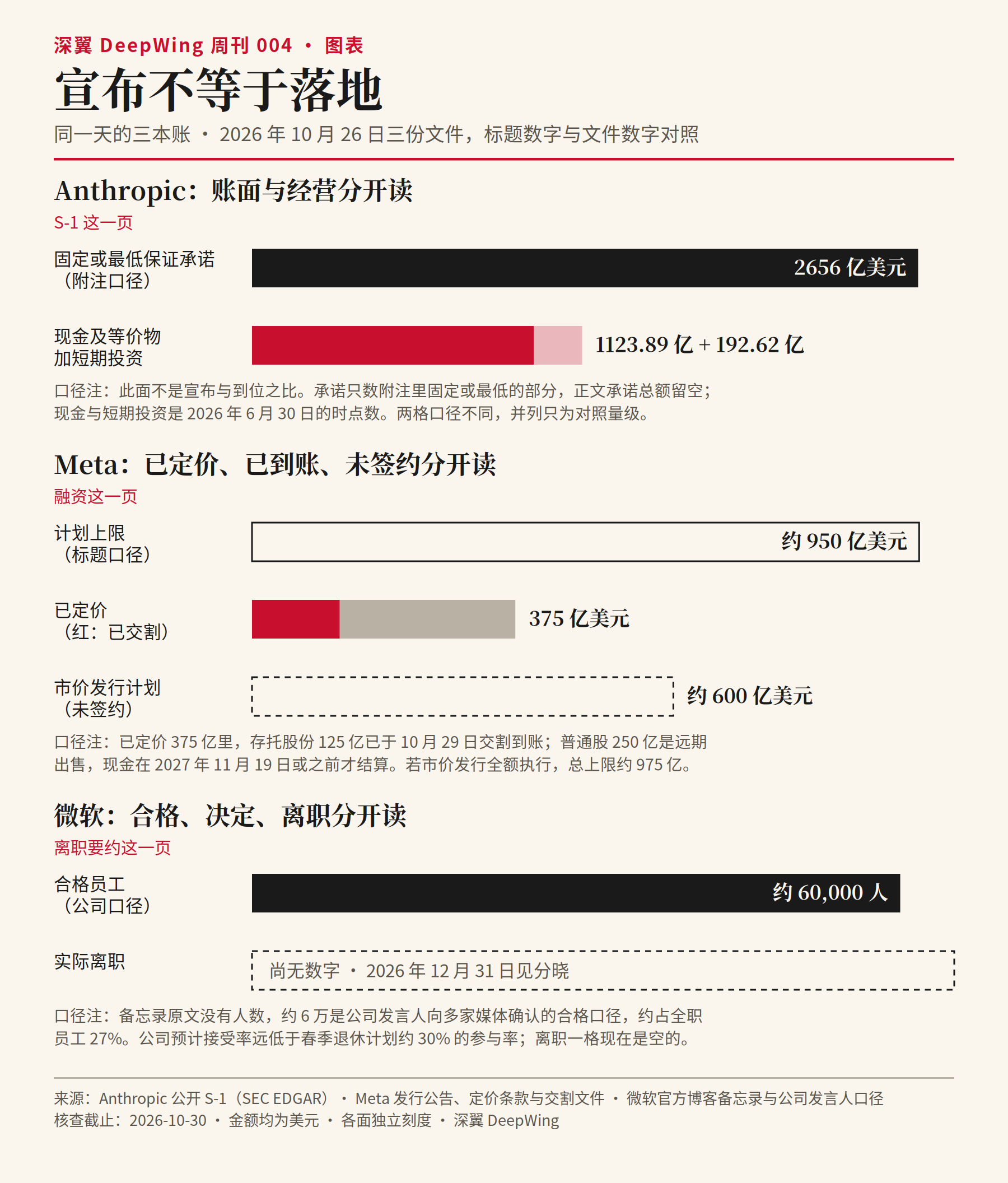
图:同一天的三本账主图。三页账的标题数字与文件数字并排:950 亿是计划上限,6 万是合格人数,S-1 的主新闻在留空处。
第一页:Anthropic 的 S-1,账面与经营分开读
Anthropic, PBC 是一家特拉华州注册的公益公司。它在 2026 年 6 月 1 日秘密递交过 S-1 草案,10 月 26 日转为公开。文件已申请在纳斯达克全球精选市场上市,代码 ANT;发行 A 类普通股,由公司与售股股东共同出售,公司不从售股股东出售的股份中获得任何收益;承销团由高盛与摩根士丹利领衔。截至 10 月 29 日,EDGAR 上尚无补入价格区间的修订版。
这一页真正的主新闻是四处空白。公开版是初步招股书,发行价区间在原文里写的是「介于 ___ 美元与 ___ 美元之间」,发行股份数与发行总规模未填;公司签有含最低采购承诺与照付不议条款的算力协议,无论实际使用量如何均须付款,但承诺支出总额一栏同样留空,原文只写「超过 ___ 美元,绝大部分与算力相关」;截至 2026 年 10 月 31 日的运行率收入也是占位符。媒体所传的 IPO 目标估值 1.5 万亿至 2 万亿美元、募资至多 1000 亿美元,均不在文件之内,是媒体口径,不是公开披露。
账面数字则要拆开读。2026 年上半年,公司净亏损 807.48 亿美元,看上去触目惊心;但其中可转换票据、衍生负债与 SAFE 的公允价值变动一项即达 723.88 亿美元。招股书说明,该项随公司估值上升而扩大,是非现金会计计提。公司估值越高,这项账面亏损越大。把这一项剥开,经营面是另一幅图景:同期经营亏损收窄至 6.93 亿美元;季度数据表显示,2026 年第二季度经营利润 9.74 亿美元,是报表期内首个单季经营盈利;上半年经营活动现金流为正 39.29 亿美元,是报表期内首个半年转正。收入一侧,2023 年为 0.41 亿美元,2025 年为 45.85 亿美元,2026 年上半年已达 162.86 亿美元。资产负债表上,2026 年 6 月 30 日现金及等价物 1123.89 亿美元,另有短期投资 192.62 亿美元。需要另外标注的还有两笔:2025 年净亏损中含 Bartz 诉讼和解费用 15 亿美元,为一次性支出;公司员工约 5,300 人(截至 2026 年 9 月 30 日),过去十二个月收入在 10 万美元以上的客户超过 11,900 家,一年前为 950 多家。
算力承诺这一栏,正文只给了性质、没给数字,但附注里数了一部分:截至 2026 年 6 月 30 日,这类协议下预期的固定或最低保证承诺约为 2656 亿美元,未写明固定或最低金额的协议不计入这个数,文件称其付款预计将相当可观。正文空白与附注的固定部分要分开读。约 5180 亿美元的多年期基础设施承诺(其中谷歌约 1111 亿美元、亚马逊约 1100 亿美元、微软约 314 亿美元)来自路透社 2026 年 9 月 28 日对一份未公开草案的报道,不在公开 S-1 内。本文只以这一口径引用它,不把它写成已公开披露。
治理结构写在文件里,是这一页少数没有留空的部分。长期利益信托(Long-Term Benefit Trust)持有 T 类普通股,有权选举与罢免董事会多数成员,信托本身是财务上无利害关系的独立体。由联合创始人设立的创始人实体将持有 1 股 F 类普通股,其表决权等于公司全部已发行股本总表决权的 50.1%,T 类董事选举事项除外。文件还确认公司在 2026 年 5 月至 6 月出售了 H-1 系列优先股;据公司 2026 年 5 月 28 日的自有公告,H 轮融资 650 亿美元,投后估值 9650 亿美元。注意,这组估值数字来自公司公告,不是 S-1 的报表数字。
第二页:Meta 的融资,已定价、已到账、未签约三层分开读
950 亿美元是这一页的标题数字,也是最容易读错的一个。它是计划上限:启动时约 350 亿美元的承销发行,加一项约 600 亿美元的市价发行计划。定价之后承销部分升到约 375 亿美元;若市价发行按 600 亿美元全额执行,计划总上限约为 975 亿美元。三个层次必须分开。
先看已定价一层。普通股部分由启动时的约 225 亿美元上调至 250 亿美元:4,000 万股 A 类普通股,发行价每股 625.00 美元,定价日为 10 月 26 日(承销商若全额行使超额配售权,则为 4,600 万股,普通股部分另有 37.5 亿美元的超额配售额度(600 万股))。存托股份部分为 2.5 亿股,每股 50 美元,合计 125 亿美元(承销商另有 3,750 万股、约 18.75 亿美元的超额配售额度,30 天内行使);每股存托股份代表二十分之一股 A 系列强制可转换优先股,优先股清算优先额每股 1,000 美元,股息率定为 6.50%,将于 2029 年 8 月 15 日前后自动转为普通股。基石投资者一栏,英伟达、AMD、博通表示有意在普通股发行中合计认购至多 50 亿美元,发行文件明示该意向不具约束力。
再看已到账一层。到 10 月 29 日为止,真正交割到账的只有存托股份的 125 亿美元:最终招股书补充文件 10 月 28 日提交,存托股份 10 月 29 日以代码 METAM 登记上市并交割。普通股的 250 亿美元是远期出售安排:公司与摩根士丹利资本服务、高盛签订远期出售协议,承销商先行借股出售,公司在结算之前不收任何款项,可以在 2027 年 11 月 19 日或之前自选日期结算,按发行价扣除承销折扣收现金。也就是说,已定价的 375 亿美元里,250 亿美元的现金还在 2027 年。
最后是未签约一层。约 600 亿美元的市价发行计划,标的为新设的无表决权 C 类普通股。启动文件明示:尚未签订任何协议,时间、规模、条款均未定,不保证设立,预计在 2027 年第一季度之后。这一层目前是意向,不是融资。
资金用途也要照文件读。发行文件的标题句写的是「支持 Meta 持续投资 AI 基础设施与个人超级智能」;但两部分承销发行的净收益在法律口径上都只写了「一般公司用途」,文件没有点名任何具体数据中心项目。外界常把这笔钱与 Hyperion 园区挂钩,但 Hyperion 在 2025 年 10 月的合资安排(与 Blue Owl 等,开发成本约 270 亿美元)是另一笔项目层融资,不属本次发行。同一份文件给出的背景数字是:2026 年资本开支预计 1350 亿至 1450 亿美元;2026 年前三季度经营现金流 970 亿美元;三季度末现金、等价物与有价证券约 820 亿美元;三季度收入 646 亿美元,同比增长 26%,净利 99 亿美元;信用评级为 Aa3 与 AA-。
附带一个同日注脚:Meta 本次所用储架注册的备案号为 333-299631,与 Anthropic 的 S-1 备案号 333-299633 仅差两位。两份文件同一天进入 EDGAR,这只是备案序号层面的巧合,不具实质含义。
第三页:微软的自愿离职要约,合格、决定、离职三层分开读
微软这一页的一手文件是官方博客上的一篇备忘录,《Introducing a Voluntary Exit Offer》,署名为执行副总裁兼首席人力官 Amy Coleman,原文是发在内部 Viva Engage 上的帖子,略作编辑后对外发布。备忘录说,公司推出自愿离职要约,面向参与组织内的合格员工,给「可能正在考虑公司之外未来」的员工一个带支持离职的选择,也给参与组织多一种按变化中的需求调整人力的办法。范围是加拿大、印度、英国、美国四国参与团队中职级 70 级及以下的员工;要约限时、自愿,提供财务支持与职业规划资源;每个组织按自身业务优先事项决定是否参加,有些参加,有些不参加。该计划承接今年早些时候的自愿退休计划,合格员工在数小时内收到载有个人要约细节的邮件链接。
备忘录没有写的东西,恰恰是标题里最响的部分:它没有出现合格人数,没有决定截止日,没有离职日期,没有补偿金额,没有参与团队名单,通篇也没有出现 AI 一词,给出的理由只有灵活性与适应变化中的需求。
6 万这个数字不在备忘录里。它是合格人数,来自公司发言人向 Business Insider、GeekWire、TechCrunch、Barron's 等多家媒体提供并确认的口径。22.3 万名全职员工(2026 年 6 月 30 日,公司年报口径)是分母,6 万约占 27%。一个细节值得记下:路透社的稿件注明微软未向路透单独确认该数字,其稿件的数字引自 Business Insider 的发言人口径。据 GeekWire 与公司说明,资格没有年龄、工龄、绩效要求,70 级及以下涵盖总经理与部分副总裁职衔,不包括公司副总裁。
决定一层同样来自公司口径经媒体:决定期到 12 月第一周,接受者于 2026 年 12 月 31 日离职;补偿与公司标准遣散框架大致相同,包括按工龄与职级计的基本工资、股权继续归属、固定期限医疗与职业过渡服务。公司没有设接受人数目标,并经 GeekWire 表示,预计接受比例将远低于今年春季自愿退休计划约 30% 的参与率。春季计划面向美国员工,与年龄及工龄挂钩,合格池约为本次的七分之一。
离职一层现在还是空的。要到 12 月 31 日,才知道 6 万名合格员工里有多少人真的离开。所以本页的读法只有一句:6 万是合格,不是决定,更不是离职。
至于这一页与 AI 的关系,必须把账分开。备忘录本身没有提 AI。与 AI 的因果是媒体归因:CNBC 的标题写「AI 带来效率推进之际」,Barron's 的标题写「为 AI 建设降本」;流传的参与与排除团队名单来自路透、The Verge、Bloomberg 的未具名知情人士,各家名单互有出入,公司从未公布名单。「要约为 AI 买单」是媒体框架,不是公司自述。
对账:三把尺子并排
把三页账按同一张表对齐,宣布、已兑现、还欠三格各是什么,一目了然:
| 对象 | 宣布了什么 | 已兑现什么 | 还欠什么 |
|---|---|---|---|
| Anthropic | 公开招股书与上市申请(代码 ANT),把财务与治理摆上台面 | 财务报表公开(中期数未经审计):收入规模、2026 年第二季度单季经营盈利、上半年经营现金流转正,治理结构(长期利益信托加创始人 50.1% 表决权)写明 | 发行价与估值、发行规模、算力承诺正文总额、运行率收入、生效与挂牌 |
| Meta | 至多约 950 亿美元股权融资计划,2026 年资本开支 1350 亿至 1450 亿美元 | 约 375 亿美元于 10 月 26 日定价,存托股份 125 亿美元于 10 月 29 日交割到账 | 普通股 250 亿美元现金待远期结算(2027 年 11 月前),市价发行 600 亿美元未签约,C 类股未开始交易 |
| 微软 | 向约 6 万名合格员工发出自愿离职要约,四国、70 级及以下 | 计划上线,个人要约邮件已发(据博客,数小时内送达) | 接受率与实际离职人数(12 月 31 日见分晓),遣散成本披露;公司从未自述此事与 AI 的因果,归因账仍空着 |
深翼判读:这一天最大的三个数字,全部不是文件里最硬的数字。2 万亿的估值想象不在文件内,950 亿是上限口径,6 万是合格口径。标题数字与文件数字之间的落差,就是这一天真正的新闻。
深翼判读:已兑现的部分都要往后翻几页才找得到。Anthropic 的单季经营盈利藏在季度数据表里;Meta 真正到账的 125 亿美元,要等到 10 月 29 日的交割文件才坐实;微软的兑现要等到 12 月 31 日。宣布的数字最大声,已经落地的都在文件后段。
深翼判读:三页的归因强度并不相同,不能读成同一个故事。Meta 的文件自己把 AI 写进标题句,但法律口径的资金用途只写一般公司用途;Anthropic 的 807 亿账面巨亏主要是自身估值上升带来的会计镜像,与经营烧钱是两回事;微软这一页,公司文件里连 AI 一词都没有,因果全在媒体的标题里。
深翼判读:这正是「证明之年」的读法:不问宣布了什么,问哪一格已经填上。Anthropic 填上了报表所载的经营面,还欠价格;Meta 填上了定价,还欠到账与签约;微软填上了要约本身,还欠决定与离职。
追踪节点
三页账都留了后续节点。以下日期中,凡属媒体预期或公司未公布者,标注待核。本刊将逐节点回访对账。
| 对象 | 节点 | 预计时间 | 看什么 |
|---|---|---|---|
| Anthropic | 修订版招股书补入发行价区间 | 路演前,媒体称 11 月 9 日当周路演(待核) | 估值落点、发行规模、算力承诺总额与运行率收入是否仍留空 |
| Anthropic | 定价与挂牌首日 | 媒体预期 11 月下半月(待核) | 最终估值与募资额,对 9650 亿美元私募估值的溢价幅度 |
| Anthropic | 上市后首份季度报告 | 2027 年初 | 票据与 SAFE 转股后公允价值计提的变化,算力承诺明细 |
| Meta | 超额配售行使结果 | 2026 年 11 月下旬前 | 承销总额最终锁定在 375 亿美元还是上探约 431 亿美元 |
| Meta | 普通股远期结算 | 2027 年 11 月 19 日或之前,公司自选日期 | 250 亿美元现金的实际到账节奏,看各季报告披露 |
| Meta | C 类股开始交易与市价发行协议签订 | 预计 2027 年第一季度 | 600 亿美元计划是否落地、首批出售规模 |
| Meta | 优先股强制转换 | 2029 年 8 月 15 日前后 | 转股价格与稀释结果(远期节点) |
| 微软 | 自愿离职要约决定截止 | 2026 年 12 月第一周 | 是否有接受规模的公开口径 |
| 微软 | 接受者离职日 | 2026 年 12 月 31 日 | 实际离职人数 |
| 微软 | 2027 财年第二季度业绩与季度报告 | 2027 年 1 月下旬 | 接受人数、遣散费用,与春季退休计划约 30% 的对照 |
本篇研究页为可引用正本,附引用格式与登记册链接:《同一天的三本账》研究页
Three Ledgers, One Day
On October 26, 2026, a public prospectus, a $95 billion financing plan, and a voluntary exit offer sent to some 60,000 employees all landed on the same day. None of the three pages reads the way its headline does.
This issue's full text is a DeepWing deep research piece: three ledgers that landed on a single day, October 26, 2026, Anthropic's public prospectus, Meta's financing plan of up to about $95 billion, and Microsoft's voluntary exit offer to some 60,000 eligible employees.
Lead
At 9:00:11 in the morning, Eastern Time, on October 26, 2026, the SEC's EDGAR system accepted Anthropic's public Form S-1. The same day, a Meta offering announcement carried the same date, October 26. At 11:33:56, Microsoft's official blog posted a voluntary exit offer. One morning, three sheets of paper.
Read by headline, the day tells a tidy story: the capital ledger and the labor ledger turned a page for AI on the same day. One company put its finances and governance on the table to go public, one asked for $95 billion, and one handed an exit option to some 60,000 employees. But none of the three pages survives a headline reading. The news on the first page is what the filing left blank. The $95 billion on the second page is a planned ceiling, not money received. The 60,000 on the third page is the number of employees eligible for an offer, not the number leaving.
So each page gets its own ruler. Page one: read the books and the business separately. Page two: separate what has been priced, what has been received, and what has not been signed. Page three: separate who is eligible, who decides, and who actually departs. Judgments are held for the reconciliation section at the end, and labeled there. This piece is also a specimen for this season's theme, the year of proof: do not ask what was announced, ask which cell has been filled in.

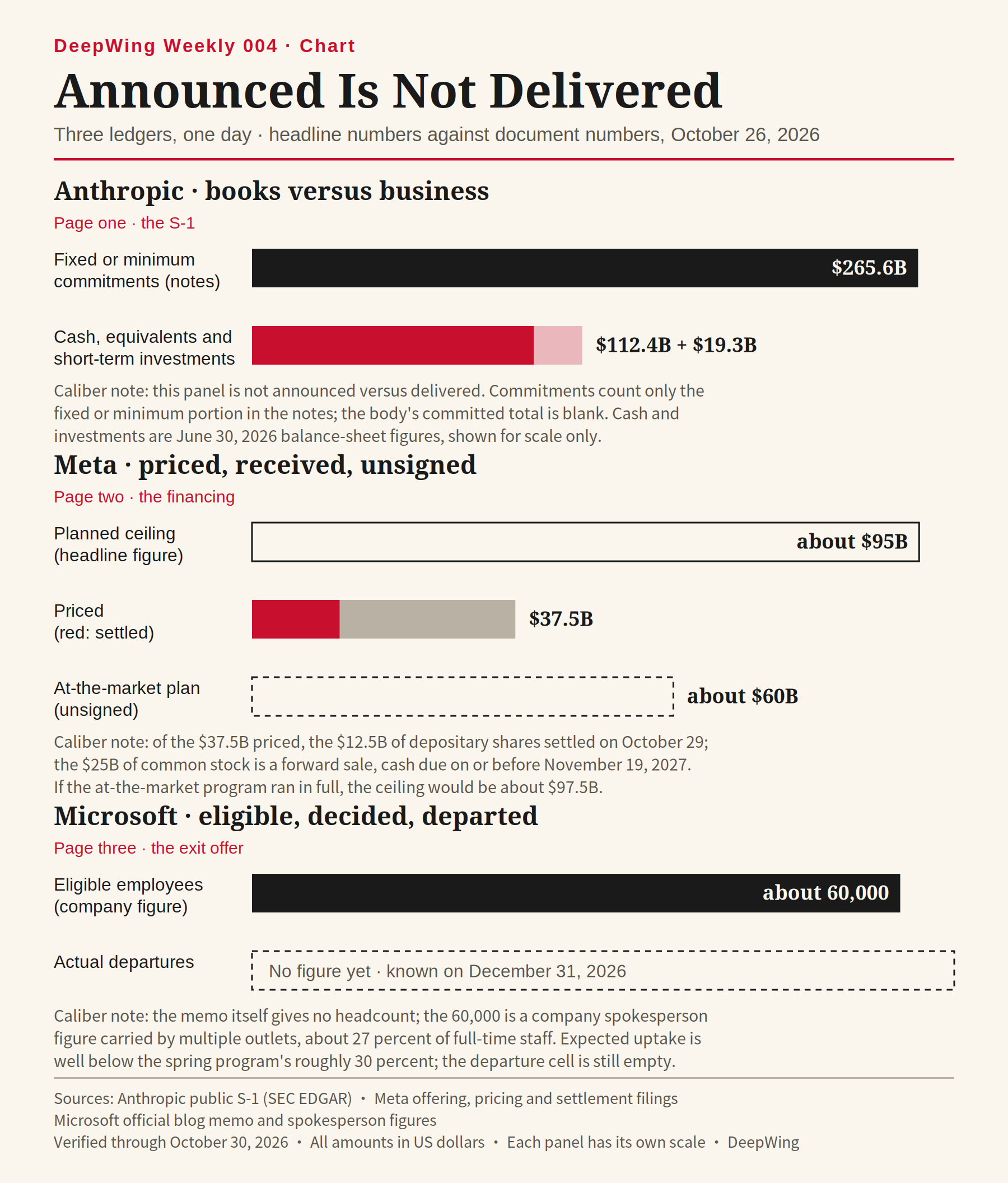
Figure: the main chart for Three Ledgers, One Day. Headline numbers beside document numbers on all three pages: the $95 billion is a planned ceiling, the 60,000 an eligibility count, and the S-1's headline sits in its blanks.
Page One: Anthropic's S-1, Read the Books and the Business Separately
Anthropic, PBC is a Delaware public benefit corporation. It filed a draft S-1 confidentially on June 1, 2026, and went public with the filing on October 26. The company has applied to list on the Nasdaq Global Select Market under the ticker ANT. The offering is Class A common stock, sold by the company and by selling stockholders; the company receives no proceeds from the shares sold by selling stockholders. Goldman Sachs and Morgan Stanley lead the underwriting syndicate. As of October 29, no amended filing with a price range had appeared on EDGAR.
The real headline on this page is four blanks. The public version is a preliminary prospectus. The price range reads, in the document's own words, between $___ and $___ per share; the number of shares and the total offering size are not filled in. The company discloses that it has signed compute agreements with minimum purchase commitments and take-or-pay terms, payable regardless of actual usage, but the total committed spend is also blank in the body: the text says only that it exceeds $___ , with the vast majority related to compute. One qualification belongs here: the notes to the financial statements do count the fixed portion. As of June 30, 2026, expected future fixed or minimum guaranteed commitments under these agreements were approximately $265.6 billion; agreements that do not specify a fixed or minimum amount are excluded from that figure, and the filing says payments under them are expected to be significant. The blank is the body's total; the notes count only what is fixed. Run-rate revenue as of October 31, 2026 is likewise a placeholder. The figures circulating in media coverage, an IPO valuation target of $1.5 trillion to $2 trillion and a raise of up to $100 billion, appear nowhere in the filing. They are media figures, not public disclosure.
The book numbers need to be taken apart before they are read. For the first half of 2026, the company reported a net loss of $80.748 billion, a startling figure until its composition is examined: changes in the fair value of convertible notes, derivative liabilities, and SAFEs account for $72.388 billion of it. The prospectus explains that this item grows as the company's valuation rises. It is a non-cash accounting charge. The higher the valuation, the larger the paper loss. Strip that item away and the operating picture looks different. The operating loss for the same half narrowed to $693 million. The quarterly table shows an operating profit of $974 million in the second quarter of 2026, the first single-quarter operating profit in the reporting period. Operating cash flow for the half was positive $3.929 billion, the first positive half in the period. On the revenue side: $41 million in 2023, $4.585 billion in 2025, and $16.286 billion in the first half of 2026 alone. On the balance sheet, cash and equivalents stood at $112.389 billion as of June 30, 2026, with a further $19.262 billion in short-term investments. Two further items deserve separate labels: the 2025 net loss includes a $1.5 billion Bartz litigation settlement, a one-time charge; and the company had about 5,300 employees as of September 30, 2026, with more than 11,900 customers generating over $100,000 in revenue over the past twelve months, up from just over 950 a year earlier.
On compute commitments, the body's total is blank; the notes count only the fixed or minimum portion, approximately $265.6 billion as of June 30, 2026, and exclude the agreements without fixed amounts. The roughly $518 billion in multi-year infrastructure commitments (about $111.1 billion with Google, about $110 billion with Amazon, about $31.4 billion with Microsoft) comes from a Reuters report of September 28, 2026 on an undisclosed draft. It is not in the public S-1. This article cites it only in that capacity, as media reporting on an undisclosed draft, and not as disclosed fact.
Governance, by contrast, is one of the few sections the filing does not leave blank. The Long-Term Benefit Trust holds the Class T stock and has the power to elect and remove a majority of the board; the trust is an independent body with no financial interest. A founder entity established by the co-founders will hold a single share of Class F stock carrying voting power equal to 50.1 percent of the total voting power of all outstanding capital stock, except in the election of Class T directors. The filing also confirms that the company sold Series H-1 preferred stock in May and June 2026. According to the company's own announcement of May 28, 2026, the Series H round raised $65 billion at a post-money valuation of $965 billion. Note the sourcing: those valuation figures come from a company announcement, not from the S-1 financial statements.
Page Two: Meta's Financing, Priced, Received, and Unsigned Are Three Different Things
The $95 billion on this page is the headline number, and the easiest one to misread. It is a planned ceiling: roughly $35 billion of underwritten offerings at launch, plus a planned at-the-market program of about $60 billion. After pricing, the underwritten portion rose to about $37.5 billion; if the at-the-market program were executed in full at $60 billion, the planned ceiling would be about $97.5 billion. The three layers have to be kept apart.
Start with what has been priced. The common stock portion was upsized from about $22.5 billion at launch to $25 billion: 40 million shares of Class A common stock at $625.00 per share, priced on October 26 (46 million shares if the underwriters exercise their overallotment option in full; the common stock overallotment is a further $3.75 billion). The depositary share portion is 250 million shares at $50 each, totaling $12.5 billion (the underwriters hold a further overallotment option over 37.5 million depositary shares, about $1.875 billion, exercisable for 30 days). Each depositary share represents one twentieth of a share of Series A mandatory convertible preferred stock, with a liquidation preference of $1,000 per preferred share; the dividend rate was set at 6.50 percent, and the preferred converts automatically into common stock on or around August 15, 2029. On cornerstone investors, Nvidia, AMD, and Broadcom indicated an interest in purchasing up to $5 billion combined in the common stock offering; the offering document states expressly that the indication is not binding.
Next, what has been received. As of October 29, the only portion that has actually settled is the $12.5 billion of depositary shares: the final prospectus supplement was filed on October 28, and the depositary shares were registered, listed under the ticker METAM, and settled on October 29. The $25 billion of common stock is structured as a forward sale. The company entered forward sale agreements with Morgan Stanley Capital Services and Goldman Sachs; the underwriters borrow and sell the shares first, and the company receives no proceeds until settlement. The company may settle on dates of its choosing on or before November 19, 2027, receiving cash at the offering price less the underwriting discount. In other words, of the $37.5 billion priced, $25 billion of the cash sits in 2027.
Finally, what has not been signed. The roughly $60 billion at-the-market program would issue a newly created class of non-voting Class C common stock. The launch document states plainly that no agreement has been signed, that timing, size, and terms are all undecided, that there is no assurance the program will be established, and that it is expected only after the first quarter of 2027. For now, this layer is an intention, not a financing.
Use of proceeds must also be read as the document reads. The offering document's headline sentence speaks of supporting Meta's continued investment in AI infrastructure and personal superintelligence. But the net proceeds of both underwritten tranches are described, in the legal language that governs, only as being for general corporate purposes. The document names no specific data center project. Coverage often ties this money to the Hyperion campus, but Hyperion's joint venture arrangement of October 2025 (with Blue Owl and others, development cost of about $27 billion) is a separate, project-level financing and is not part of this offering. Background figures from the same document: capital expenditure for 2026 is expected at $135 billion to $145 billion; operating cash flow for the first three quarters of 2026 was $97 billion; cash, equivalents, and marketable securities stood at about $82 billion at the end of the third quarter; third-quarter revenue was $64.6 billion, up 26 percent year on year, with net income of $9.9 billion; credit ratings are Aa3 and AA-minus.
A footnote on the same-day point: the shelf registration Meta used carries file number 333-299631, two digits away from Anthropic's S-1 file number, 333-299633. Both documents entered EDGAR on the same day. That is a coincidence of filing sequence and carries no substantive meaning.
Page Three: Microsoft's Voluntary Exit Offer, Eligible, Decided, and Departed Are Three Different Things
The primary document on this page is a memo on Microsoft's official blog, "Introducing a Voluntary Exit Offer," signed by Amy Coleman, Executive Vice President and Chief People Officer. The text began as an internal Viva Engage post and was lightly edited for publication. The memo says the company is introducing a voluntary exit offer for eligible employees in participating organizations: a supported exit for employees "who may be considering a future outside the company," and one more way for participating organizations to adjust staffing to changing needs. The scope is employees at level 70 and below in participating teams in four countries: Canada, India, the United Kingdom, and the United States. The offer is time-limited and voluntary, with financial support and career planning resources. Each organization decides for itself whether to participate, based on its business priorities, customer commitments, and staffing needs; some participate, some do not. The program builds on a voluntary retirement program run earlier this year, and eligible employees received an email link with their personal offer details within hours.
What the memo does not contain is precisely what the headlines carried. It gives no eligible headcount, no decision deadline, no departure date, no severance amounts, and no list of participating teams. The word AI does not appear anywhere in it. The reasons it gives are flexibility and adapting to changing needs.
The 60,000 figure is not in the memo. It is the count of eligible employees, provided and confirmed by a company spokesperson to Business Insider, GeekWire, TechCrunch, Barron's, and other outlets. Set against 223,000 full-time employees as of June 30, 2026 (the annual report figure), 60,000 is about 27 percent. One detail is worth recording: Reuters noted in its story that Microsoft did not separately confirm the number to Reuters, and that its figure traces to Business Insider's spokesperson sourcing. According to GeekWire and company explanations, eligibility carries no age, service, or performance conditions; level 70 and below includes general managers and some vice president titles, but not corporate vice presidents.
The decision layer likewise comes from company lines carried by media: the decision window runs to the first week of December, and those who accept leave on December 31, 2026. Severance is broadly in line with the company's standard framework: base pay by tenure and level, continued equity vesting, a fixed period of healthcare coverage, and career transition services. The company set no acceptance target, and, via GeekWire, said it expects the acceptance rate to come in well below the roughly 30 percent participation in the spring voluntary retirement program. That spring program covered US employees, was tied to age and service, and drew from an eligible pool about one seventh the size of this one.
The departure layer is, for now, empty. Only on December 31 will it be known how many of the 60,000 eligible employees actually leave. The reading rule for this page is one sentence: 60,000 is eligibility, not decisions, and certainly not departures.
The connection to AI on this page must be kept in a separate account. The memo itself does not mention AI. The causal link is media attribution: CNBC headlined its story with AI driving an efficiency push, and Barron's with cutting costs for the AI build-out. The circulating lists of participating and excluded teams come from unnamed sources in Reuters, The Verge, and Bloomberg reporting; the lists differ from outlet to outlet, and the company has published no list. "The offer pays for AI" is a media frame, not a company statement.
Reconciliation: The Three Rulers Side by Side
Lay the three pages over one table, announced, delivered, and still owed, and the day comes into focus:
| Company | What was announced | What has been delivered | What is still owed |
|---|---|---|---|
| Anthropic | A public prospectus and listing application (ticker ANT), finances and governance put on the table | Financial statements made public (interim figures unaudited): revenue scale, a single-quarter operating profit in Q2 2026, positive operating cash flow for the first half, and the governance structure (Long-Term Benefit Trust plus 50.1 percent founder voting power) spelled out | Price and valuation, offering size, the body total for compute commitments, run-rate revenue, effectiveness and listing |
| Meta | An equity financing plan of up to about $95 billion; 2026 capital expenditure of $135 billion to $145 billion | About $37.5 billion priced on October 26; the $12.5 billion of depositary shares settled on October 29 | The $25 billion of common stock cash awaits forward settlement (before November 2027); the $60 billion at-the-market program is unsigned; Class C stock has not begun trading |
| Microsoft | A voluntary exit offer sent to about 60,000 eligible employees, four countries, level 70 and below | The program is live; personal offer emails have been sent (within hours, per the blog) | Acceptance rate and actual departures (settled on December 31), severance cost disclosure; the company has never stated a causal link to AI, so the attribution account remains empty |
[DeepWing reading] The three biggest numbers of the day are none of them the hardest numbers in the documents. The $2 trillion valuation imagination is not in the filing. The $95 billion is a ceiling. The 60,000 is an eligibility count. The gap between headline numbers and document numbers is the actual news of the day.
[DeepWing reading] What has been delivered sits pages deep. Anthropic's single-quarter operating profit is buried in a quarterly data table. Meta's genuinely received $12.5 billion was only confirmed by a settlement document on October 29. Microsoft's delivery waits until December 31. Announced numbers speak the loudest; delivered numbers are found several pages in.
[DeepWing reading] The three pages differ in attribution strength and should not be read as one story. Meta's own document writes AI into its headline sentence, yet confines the legal use of proceeds to general corporate purposes. Anthropic's $80.7 billion paper loss is mostly an accounting mirror of its own rising valuation, a different thing from operating cash burn. On Microsoft's page, the company's document does not contain the word AI at all; the causality lives entirely in media headlines.
[DeepWing reading] That is the reading method of the year of proof: do not ask what was announced, ask which cell has been filled in. Anthropic has filled in the operating picture carried in its statements and still owes a price. Meta has filled in pricing and still owes receipt and signatures. Microsoft has filled in the offer itself and still owes decisions and departures.
Tracking Nodes
All three pages leave nodes behind. Dates drawn from media expectations or not published by the company are marked as unverified. DeepWing will revisit each node as it falls due.
| Company | Node | Expected timing | What to look for |
|---|---|---|---|
| Anthropic | Amended prospectus with the price range filled in | Before the roadshow; media report a roadshow in the week of November 9 (unverified) | Where the valuation lands, the offering size, and whether total compute commitments and run-rate revenue are still blank |
| Anthropic | Pricing and first trading day | Media expect the second half of November (unverified) | Final valuation and raise, and the premium over the $965 billion private valuation |
| Anthropic | First quarterly report after listing | Early 2027 | How the fair value charges change once notes and SAFEs convert, and the compute commitment detail |
| Meta | Overallotment exercise result | Before late November 2026 | Whether the underwritten total locks at $37.5 billion or rises toward about $43.1 billion |
| Meta | Forward settlement of the common stock | On or before November 19, 2027, on dates the company chooses | The actual cadence of the $25 billion cash receipt, tracked through quarterly reports |
| Meta | Class C trading begins and the at-the-market agreement is signed | Expected in the first quarter of 2027 | Whether the $60 billion plan materializes, and the size of the first sales |
| Meta | Mandatory conversion of the preferred stock | On or around August 15, 2029 | Conversion price and dilution outcome (distant node) |
| Microsoft | Voluntary exit offer decision deadline | First week of December 2026 | Whether any acceptance figure becomes public |
| Microsoft | Departure date for those who accepted | December 31, 2026 | The actual number of departures |
| Microsoft | Fiscal Q2 2027 results and quarterly report | Late January 2027 | Acceptance count, severance costs, and the comparison with the spring retirement program's roughly 30 percent |
The research page carries the citable version of this piece, with its citation format and register links: Three Ledgers, One Day, research page
每周一封深翼情报One DeepWing intelligence letter, every week
一条重要变化,一个独立判断,一组可追溯证据,以及一个值得持续跟踪的问题。One material change, one independent judgment, one set of traceable evidence, and one question worth tracking over time.
只用来发送周刊,可随时退订。Used only to send the Weekly. Unsubscribe any time.
已收到,下一期直接送到你的邮箱。Got it. The next issue will land in your inbox.
刚才没发出去,请稍后再试,或到纠错与联系页订阅。That did not go through. Please retry, or subscribe on the Contact page.