至于这一页与 AI 的关系,必须把账分开。备忘录本身没有提 AI。与 AI 的因果是媒体归因:CNBC 的标题写「AI 带来效率推进之际」,Barron's 的标题写「为 AI 建设降本」;流传的参与与排除团队名单来自路透、The Verge、Bloomberg 的未具名知情人士,各家名单互有出入,公司从未公布名单。「要约为 AI 买单」是媒体框架,不是公司自述。
By DeepWing·Published 2026-10-29·Last checked 2026-11-04·Read ~18 min
AI Infrastructure & EconomicsCross-tag: AI Systems & ArchitectureReading time: About 18 min
Research question
On October 26, 2026, a public prospectus (Anthropic), an equity financing plan of up to about $95 billion (Meta), and a voluntary exit offer (Microsoft) all landed on the same day. How far is each page's headline number from the cells its document actually fills in: what was announced, what has been delivered, and what is still owed?
Method
Each page is read in layers: on the Anthropic page the book numbers are read apart from the operating picture; on the Meta page, priced, received and unsigned are kept apart; on the Microsoft page, eligible, decided and departed are kept apart. The three pages are then aligned on a single announced, delivered, still owed grid. Any judgment that does not come from the documents is labeled a DeepWing reading.
Evidence grade
Multi-source verified
Verified through
2026-10-29
Key findings
1. None of the day's three biggest numbers is the hardest number in its document: the $2 trillion valuation talk is not in the S-1, the $95 billion is a planned ceiling, and the 60,000 is an eligibility count; the gap between headline numbers and document numbers is the day's real news. 2. What has been delivered sits in the back pages: Anthropic's single-quarter operating profit is in a quarterly data table, Meta's genuinely received $12.5 billion was confirmed only by the October 29 settlement documents, and Microsoft's delivery waits until December 31. 3. The three pages carry different attribution strength and are not one story: Meta's document writes AI into its headline sentence while its legal use of proceeds says general corporate purposes only; Anthropic's $80.748 billion paper loss is mostly an accounting mirror of its own rising valuation; Microsoft's memo never mentions AI at all, and the causality lives in media headlines.
Limitations
The Microsoft memo is a lightly edited public version of an internal post; the eligible count and decision window are company lines carried by media, and the company has published no team list or country split. Eight items, including the roadshow timetable and Meta's overallotment result, remained unverified as of October 29, 2026, and are carried in the text as open items only, not conclusions.
Watch next
Whether Anthropic's amended prospectus fills in the price range, and whether the compute commitment total and run-rate revenue stay blank; whether Meta's $60 billion at-the-market program is signed, and the cadence of the $25 billion forward settlement; Microsoft's acceptance count and actual departures on December 31, and the severance cost disclosure in its January 2027 quarterly report.
CoverageAnthropic's public S-1 · Meta's equity financing plan · Microsoft's voluntary exit offerAs ofAll three landed on October 26, 2026; checked through October 29, 2026LabelsAnnounced, delivered and still owed kept in separate cells; headline numbers read apart from document numbers
Lead
At 9:00:11 in the morning, Eastern Time, on October 26, 2026, the SEC's EDGAR system accepted Anthropic's public Form S-1. The same day, a Meta offering announcement carried the same date, October 26. At 11:33:56, Microsoft's official blog posted a voluntary exit offer. One morning, three sheets of paper.
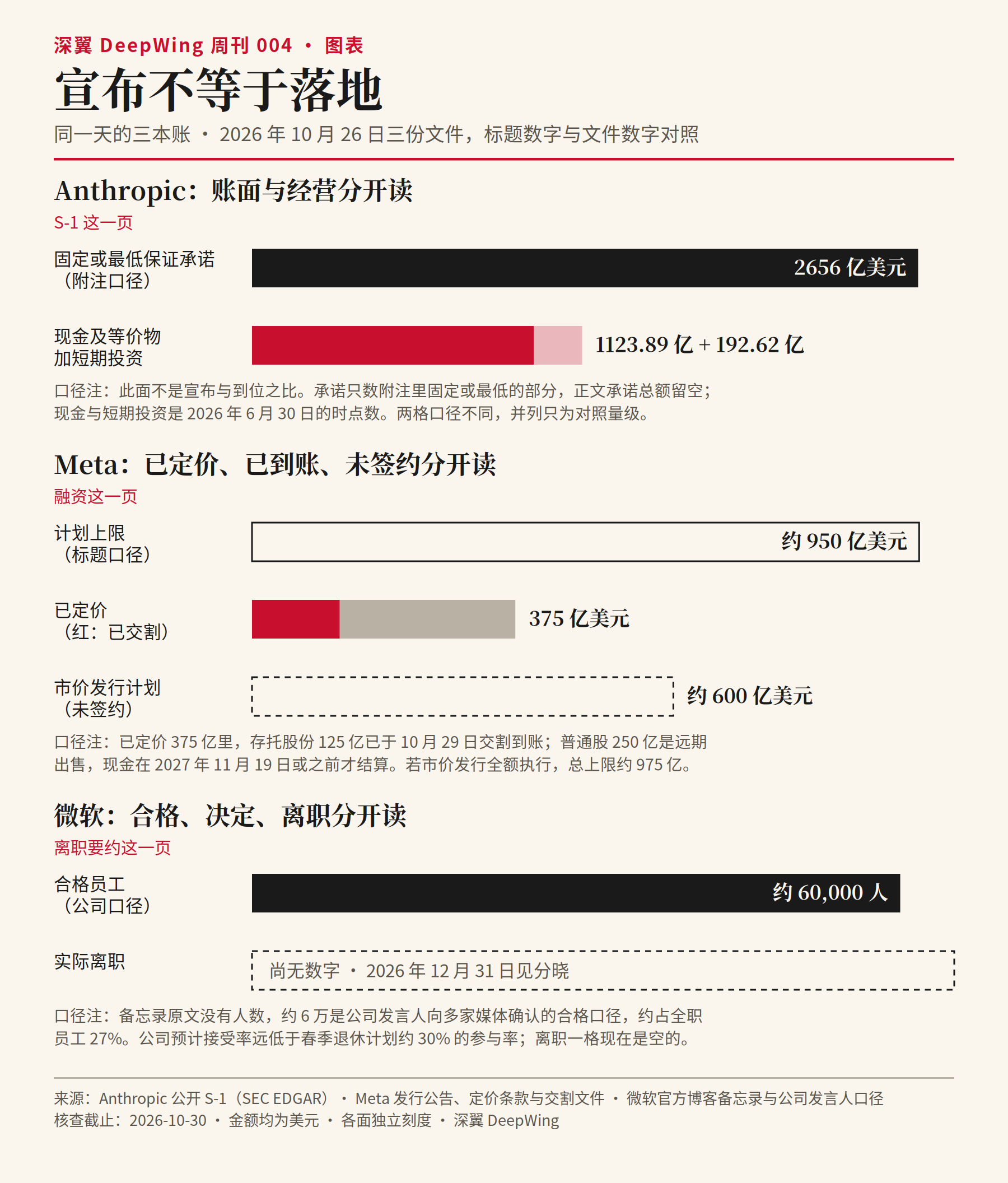
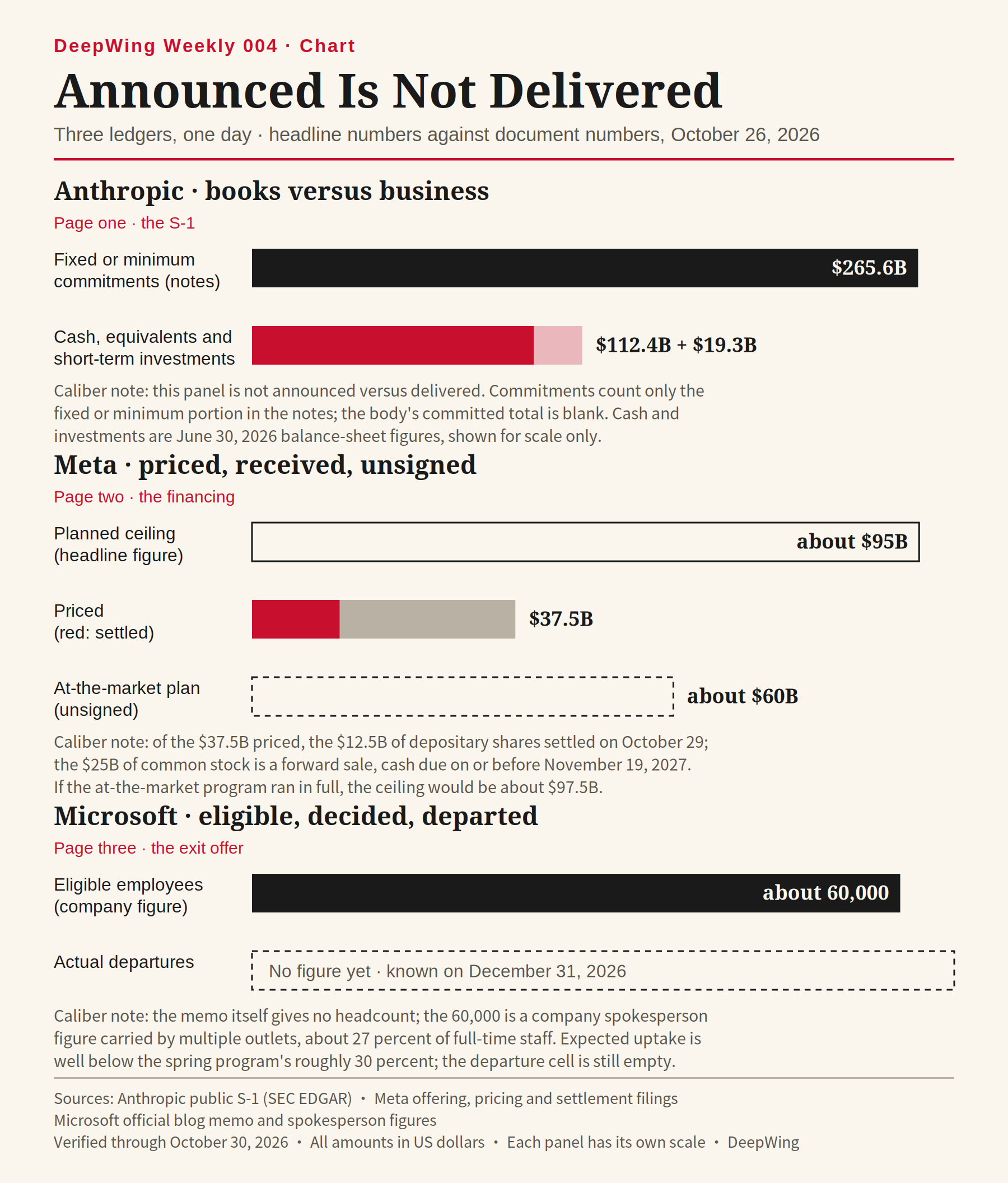
Figure: the main chart for Three Ledgers, One Day. Headline numbers beside document numbers on all three pages: the $95 billion is a planned ceiling, the 60,000 an eligibility count, and the S-1's headline sits in its blanks.
Read by headline, the day tells a tidy story: the capital ledger and the labor ledger turned a page for AI on the same day. One company put its finances and governance on the table to go public, one asked for $95 billion, and one handed an exit option to some 60,000 employees. But none of the three pages survives a headline reading. The news on the first page is what the filing left blank. The $95 billion on the second page is a planned ceiling, not money received. The 60,000 on the third page is the number of employees eligible for an offer, not the number leaving.
So each page gets its own ruler. Page one: read the books and the business separately. Page two: separate what has been priced, what has been received, and what has not been signed. Page three: separate who is eligible, who decides, and who actually departs. Judgments are held for the reconciliation section at the end, and labeled there. This piece is also a specimen for this season's theme, the year of proof: do not ask what was announced, ask which cell has been filled in.
Page One: Anthropic's S-1, Read the Books and the Business Separately
Anthropic, PBC is a Delaware public benefit corporation. It filed a draft S-1 confidentially on June 1, 2026, and went public with the filing on October 26. The company has applied to list on the Nasdaq Global Select Market under the ticker ANT. The offering is Class A common stock, sold by the company and by selling stockholders; the company receives no proceeds from the shares sold by selling stockholders. Goldman Sachs and Morgan Stanley lead the underwriting syndicate. As of October 29, no amended filing with a price range had appeared on EDGAR.
The real headline on this page is four blanks. The public version is a preliminary prospectus. The price range reads, in the document's own words, between $___ and $___ per share; the number of shares and the total offering size are not filled in. The company discloses that it has signed compute agreements with minimum purchase commitments and take-or-pay terms, payable regardless of actual usage, but the total committed spend is also blank in the body: the text says only that it exceeds $___ , with the vast majority related to compute. One qualification belongs here: the notes to the financial statements do count the fixed portion. As of June 30, 2026, expected future fixed or minimum guaranteed commitments under these agreements were approximately $265.6 billion; agreements that do not specify a fixed or minimum amount are excluded from that figure, and the filing says payments under them are expected to be significant. The blank is the body's total; the notes count only what is fixed. Run-rate revenue as of October 31, 2026 is likewise a placeholder. The figures circulating in media coverage, an IPO valuation target of $1.5 trillion to $2 trillion and a raise of up to $100 billion, appear nowhere in the filing. They are media figures, not public disclosure.
The book numbers need to be taken apart before they are read. For the first half of 2026, the company reported a net loss of $80.748 billion, a startling figure until its composition is examined: changes in the fair value of convertible notes, derivative liabilities, and SAFEs account for $72.388 billion of it. The prospectus explains that this item grows as the company's valuation rises. It is a non-cash accounting charge. The higher the valuation, the larger the paper loss. Strip that item away and the operating picture looks different. The operating loss for the same half narrowed to $693 million. The quarterly table shows an operating profit of $974 million in the second quarter of 2026, the first single-quarter operating profit in the reporting period. Operating cash flow for the half was positive $3.929 billion, the first positive half in the period. On the revenue side: $41 million in 2023, $4.585 billion in 2025, and $16.286 billion in the first half of 2026 alone. On the balance sheet, cash and equivalents stood at $112.389 billion as of June 30, 2026, with a further $19.262 billion in short-term investments. Two further items deserve separate labels: the 2025 net loss includes a $1.5 billion Bartz litigation settlement, a one-time charge; and the company had about 5,300 employees as of September 30, 2026, with more than 11,900 customers generating over $100,000 in revenue over the past twelve months, up from just over 950 a year earlier.
On compute commitments, the body's total is blank; the notes count only the fixed or minimum portion, approximately $265.6 billion as of June 30, 2026, and exclude the agreements without fixed amounts. The roughly $518 billion in multi-year infrastructure commitments (about $111.1 billion with Google, about $110 billion with Amazon, about $31.4 billion with Microsoft) comes from a Reuters report of September 28, 2026 on an undisclosed draft. It is not in the public S-1. This article cites it only in that capacity, as media reporting on an undisclosed draft, and not as disclosed fact.
Governance, by contrast, is one of the few sections the filing does not leave blank. The Long-Term Benefit Trust holds the Class T stock and has the power to elect and remove a majority of the board; the trust is an independent body with no financial interest. A founder entity established by the co-founders will hold a single share of Class F stock carrying voting power equal to 50.1 percent of the total voting power of all outstanding capital stock, except in the election of Class T directors. The filing also confirms that the company sold Series H-1 preferred stock in May and June 2026. According to the company's own announcement of May 28, 2026, the Series H round raised $65 billion at a post-money valuation of $965 billion. Note the sourcing: those valuation figures come from a company announcement, not from the S-1 financial statements.
Page Two: Meta's Financing, Priced, Received, and Unsigned Are Three Different Things
The $95 billion on this page is the headline number, and the easiest one to misread. It is a planned ceiling: roughly $35 billion of underwritten offerings at launch, plus a planned at-the-market program of about $60 billion. After pricing, the underwritten portion rose to about $37.5 billion; if the at-the-market program were executed in full at $60 billion, the planned ceiling would be about $97.5 billion. The three layers have to be kept apart.
Start with what has been priced. The common stock portion was upsized from about $22.5 billion at launch to $25 billion: 40 million shares of Class A common stock at $625.00 per share, priced on October 26 (46 million shares if the underwriters exercise their overallotment option in full; the common stock overallotment is a further $3.75 billion). The depositary share portion is 250 million shares at $50 each, totaling $12.5 billion (the underwriters hold a further overallotment option over 37.5 million depositary shares, about $1.875 billion, exercisable for 30 days). Each depositary share represents one twentieth of a share of Series A mandatory convertible preferred stock, with a liquidation preference of $1,000 per preferred share; the dividend rate was set at 6.50 percent, and the preferred converts automatically into common stock on or around August 15, 2029. On cornerstone investors, Nvidia, AMD, and Broadcom indicated an interest in purchasing up to $5 billion combined in the common stock offering; the offering document states expressly that the indication is not binding.
Next, what has been received. As of October 29, the only portion that has actually settled is the $12.5 billion of depositary shares: the final prospectus supplement was filed on October 28, and the depositary shares were registered, listed under the ticker METAM, and settled on October 29. The $25 billion of common stock is structured as a forward sale. The company entered forward sale agreements with Morgan Stanley Capital Services and Goldman Sachs; the underwriters borrow and sell the shares first, and the company receives no proceeds until settlement. The company may settle on dates of its choosing on or before November 19, 2027, receiving cash at the offering price less the underwriting discount. In other words, of the $37.5 billion priced, $25 billion of the cash sits in 2027.
Finally, what has not been signed. The roughly $60 billion at-the-market program would issue a newly created class of non-voting Class C common stock. The launch document states plainly that no agreement has been signed, that timing, size, and terms are all undecided, that there is no assurance the program will be established, and that it is expected only after the first quarter of 2027. For now, this layer is an intention, not a financing.
Use of proceeds must also be read as the document reads. The offering document's headline sentence speaks of supporting Meta's continued investment in AI infrastructure and personal superintelligence. But the net proceeds of both underwritten tranches are described, in the legal language that governs, only as being for general corporate purposes. The document names no specific data center project. Coverage often ties this money to the Hyperion campus, but Hyperion's joint venture arrangement of October 2025 (with Blue Owl and others, development cost of about $27 billion) is a separate, project-level financing and is not part of this offering. Background figures from the same document: capital expenditure for 2026 is expected at $135 billion to $145 billion; operating cash flow for the first three quarters of 2026 was $97 billion; cash, equivalents, and marketable securities stood at about $82 billion at the end of the third quarter; third-quarter revenue was $64.6 billion, up 26 percent year on year, with net income of $9.9 billion; credit ratings are Aa3 and AA-minus.
A footnote on the same-day point: the shelf registration Meta used carries file number 333-299631, two digits away from Anthropic's S-1 file number, 333-299633. Both documents entered EDGAR on the same day. That is a coincidence of filing sequence and carries no substantive meaning.
Page Three: Microsoft's Voluntary Exit Offer, Eligible, Decided, and Departed Are Three Different Things
The primary document on this page is a memo on Microsoft's official blog, "Introducing a Voluntary Exit Offer," signed by Amy Coleman, Executive Vice President and Chief People Officer. The text began as an internal Viva Engage post and was lightly edited for publication. The memo says the company is introducing a voluntary exit offer for eligible employees in participating organizations: a supported exit for employees "who may be considering a future outside the company," and one more way for participating organizations to adjust staffing to changing needs. The scope is employees at level 70 and below in participating teams in four countries: Canada, India, the United Kingdom, and the United States. The offer is time-limited and voluntary, with financial support and career planning resources. Each organization decides for itself whether to participate, based on its business priorities, customer commitments, and staffing needs; some participate, some do not. The program builds on a voluntary retirement program run earlier this year, and eligible employees received an email link with their personal offer details within hours.
What the memo does not contain is precisely what the headlines carried. It gives no eligible headcount, no decision deadline, no departure date, no severance amounts, and no list of participating teams. The word AI does not appear anywhere in it. The reasons it gives are flexibility and adapting to changing needs.
The 60,000 figure is not in the memo. It is the count of eligible employees, provided and confirmed by a company spokesperson to Business Insider, GeekWire, TechCrunch, Barron's, and other outlets. Set against 223,000 full-time employees as of June 30, 2026 (the annual report figure), 60,000 is about 27 percent. One detail is worth recording: Reuters noted in its story that Microsoft did not separately confirm the number to Reuters, and that its figure traces to Business Insider's spokesperson sourcing. According to GeekWire and company explanations, eligibility carries no age, service, or performance conditions; level 70 and below includes general managers and some vice president titles, but not corporate vice presidents.
The decision layer likewise comes from company lines carried by media: the decision window runs to the first week of December, and those who accept leave on December 31, 2026. Severance is broadly in line with the company's standard framework: base pay by tenure and level, continued equity vesting, a fixed period of healthcare coverage, and career transition services. The company set no acceptance target, and, via GeekWire, said it expects the acceptance rate to come in well below the roughly 30 percent participation in the spring voluntary retirement program. That spring program covered US employees, was tied to age and service, and drew from an eligible pool about one seventh the size of this one.
The departure layer is, for now, empty. Only on December 31 will it be known how many of the 60,000 eligible employees actually leave. The reading rule for this page is one sentence: 60,000 is eligibility, not decisions, and certainly not departures.
The connection to AI on this page must be kept in a separate account. The memo itself does not mention AI. The causal link is media attribution: CNBC headlined its story with AI driving an efficiency push, and Barron's with cutting costs for the AI build-out. The circulating lists of participating and excluded teams come from unnamed sources in Reuters, The Verge, and Bloomberg reporting; the lists differ from outlet to outlet, and the company has published no list. "The offer pays for AI" is a media frame, not a company statement.
Reconciliation: The Three Rulers Side by Side
Lay the three pages over one table, announced, delivered, and still owed, and the day comes into focus:
Company
What was announced
What has been delivered
What is still owed
Anthropic
A public prospectus and listing application (ticker ANT), finances and governance put on the table
Financial statements made public (interim figures unaudited): revenue scale, a single-quarter operating profit in Q2 2026, positive operating cash flow for the first half, and the governance structure (Long-Term Benefit Trust plus 50.1 percent founder voting power) spelled out
Price and valuation, offering size, the body total for compute commitments, run-rate revenue, effectiveness and listing
Meta
An equity financing plan of up to about $95 billion; 2026 capital expenditure of $135 billion to $145 billion
About $37.5 billion priced on October 26; the $12.5 billion of depositary shares settled on October 29
The $25 billion of common stock cash awaits forward settlement (before November 2027); the $60 billion at-the-market program is unsigned; Class C stock has not begun trading
Microsoft
A voluntary exit offer sent to about 60,000 eligible employees, four countries, level 70 and below
The program is live; personal offer emails have been sent (within hours, per the blog)
Acceptance rate and actual departures (settled on December 31), severance cost disclosure; the company has never stated a causal link to AI, so the attribution account remains empty
[DeepWing reading] The three biggest numbers of the day are none of them the hardest numbers in the documents. The $2 trillion valuation imagination is not in the filing. The $95 billion is a ceiling. The 60,000 is an eligibility count. The gap between headline numbers and document numbers is the actual news of the day.
[DeepWing reading] What has been delivered sits pages deep. Anthropic's single-quarter operating profit is buried in a quarterly data table. Meta's genuinely received $12.5 billion was only confirmed by a settlement document on October 29. Microsoft's delivery waits until December 31. Announced numbers speak the loudest; delivered numbers are found several pages in.
[DeepWing reading] The three pages differ in attribution strength and should not be read as one story. Meta's own document writes AI into its headline sentence, yet confines the legal use of proceeds to general corporate purposes. Anthropic's $80.7 billion paper loss is mostly an accounting mirror of its own rising valuation, a different thing from operating cash burn. On Microsoft's page, the company's document does not contain the word AI at all; the causality lives entirely in media headlines.
[DeepWing reading] That is the reading method of the year of proof: do not ask what was announced, ask which cell has been filled in. Anthropic has filled in the operating picture carried in its statements and still owes a price. Meta has filled in pricing and still owes receipt and signatures. Microsoft has filled in the offer itself and still owes decisions and departures.
Tracking Nodes
All three pages leave nodes behind. Dates drawn from media expectations or not published by the company are marked as unverified. DeepWing will revisit each node as it falls due.
Company
Node
Expected timing
What to look for
Anthropic
Amended prospectus with the price range filled in
Before the roadshow; media report a roadshow in the week of November 9 (unverified)
Where the valuation lands, the offering size, and whether total compute commitments and run-rate revenue are still blank
Anthropic
Pricing and first trading day
Media expect the second half of November (unverified)
Final valuation and raise, and the premium over the $965 billion private valuation
Anthropic
First quarterly report after listing
Early 2027
How the fair value charges change once notes and SAFEs convert, and the compute commitment detail
Meta
Overallotment exercise result
Before late November 2026
Whether the underwritten total locks at $37.5 billion or rises toward about $43.1 billion
Meta
Forward settlement of the common stock
On or before November 19, 2027, on dates the company chooses
The actual cadence of the $25 billion cash receipt, tracked through quarterly reports
Meta
Class C trading begins and the at-the-market agreement is signed
Expected in the first quarter of 2027
Whether the $60 billion plan materializes, and the size of the first sales
Meta
Mandatory conversion of the preferred stock
On or around August 15, 2029
Conversion price and dilution outcome (distant node)
Microsoft
Voluntary exit offer decision deadline
First week of December 2026
Whether any acceptance figure becomes public
Microsoft
Departure date for those who accepted
December 31, 2026
The actual number of departures
Microsoft
Fiscal Q2 2027 results and quarterly report
Late January 2027
Acceptance count, severance costs, and the comparison with the spring retirement program's roughly 30 percent
Sources and Standards
The three pages rest on different grades of evidence, labeled page by page in this article. The Anthropic page is verified from primary sources: the public Form S-1 read in full on SEC EDGAR, with its submission record (file number 333-299633, accession number 0001628280-26-067168); the Series H valuation figures are sourced separately to the company's own announcement of May 28, 2026. The Meta page is verified from primary sources: the offering announcement (free writing prospectus) of October 26, the pricing term sheet filed October 27, the final prospectus supplement of October 28, and the Form 8-K and listing registration of October 29, under shelf registration file number 333-299631. The Microsoft page mixes primary and multi-source material: the memo's contents are taken from the official blog text; the eligible headcount, decision window, severance framework, and expected acceptance rate are company lines, from a spokesperson and company briefings, carried consistently by Business Insider, GeekWire, TechCrunch, Barron's, Reuters, and others; the team lists and the AI causality are media relay and media attribution, and are labeled as such in the text.
All amounts are in US dollars. This article follows three number rules: the roughly $518 billion in compute commitments appears only as media reporting on an undisclosed draft, never as public disclosure; the $95 billion is written only as a planned ceiling, never as money raised; and the roughly 60,000 is written only as an eligibility count, never as departures.
The following items remained unverified as of October 29, 2026, and are carried here only as open items, not as conclusions: Meta's third-quarter free cash flow of negative $2.12 billion (reported by several outlets from the company's third-quarter results; not checked against the quarterly report itself); Anthropic's third-quarter 2026 revenue of $16.8 billion (a single secondhand source; not found in any public filing); Anthropic's roadshow and pricing timetable (an IFR-reported plan with no company confirmation, and no amended prospectus on EDGAR yet); Microsoft's fiscal 2026 property and equipment spending of about $115.9 billion (a secondhand summary of the annual report, not checked against the original); whether Microsoft's exit offer appears as a subsequent event, with severance accruals, in its fiscal Q1 2027 quarterly report (not checked); the result of Meta's overallotment options (the 30-day window has not expired); the exact decision deadline date and the country-by-country distribution of Microsoft's eligible pool (not published by the company); and the per-share price of Anthropic's Series H (a third-party database figure, not found in the S-1 text, and not used).
This piece also runs as Issue 004 of DeepWing Weekly (November 5, 2026): the issue page →
引用本文Cite this piece
深翼 DeepWing:《同一天的三本账》,2026-10-29。https://deepwingai.com/research/three-ledgers/DeepWing, "Three Ledgers, One Day", Oct 29, 2026. https://deepwingai.com/research/three-ledgers/