
CCA 备考课 · 第 1.4 课CCA COURSE · LESSON 1.4
编排拓扑Orchestration Topologies: One Center or None?
1.2 定了哪些段落值得委派,1.3 理清了委派段落的内部。这一课定段落之间怎么连接:中心坐在哪,错误归谁答。通道里传什么,调用、上下文传递与交接包的字段格式,留给 1.5。Lesson 1.2 decided which segments earn delegation, Lesson 1.3 organized the inside of those segments, and this lesson fixes how the pieces connect, where the center sits, and who answers when the wiring fails. What then travels inside the channels, invocation, context passing, and the field-level format of the handoff package, is Lesson 1.5.

YouTube
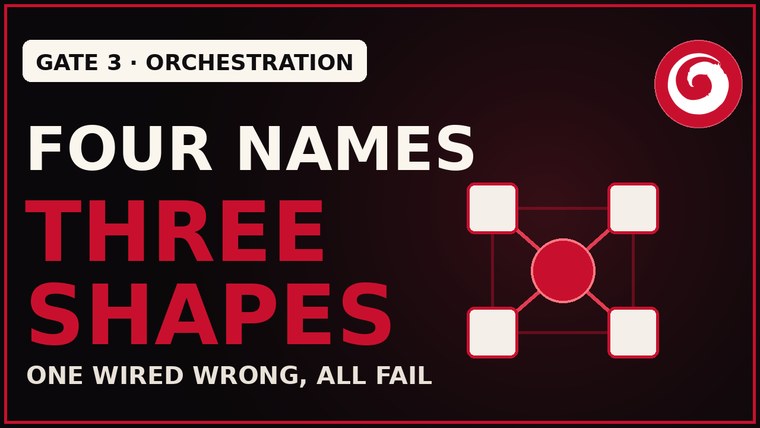
四个子智能体,彼此两两直连。搜索和分析把同一批来源查了两遍,写作收到两个互相矛盾的结论;等报告被证明是错的,消息早已散在六条通道里,谁也拼不回全貌。(开场为教学示意场景。)
本课内容
- 三个问题定住任何拓扑的性格:有没有中心、有几条路径、错误归谁,附通道算术(四个节点,六条通道;十个节点,四十五条)
- 编排者与子智能体:负责分解、委派与汇总的协调者,它的三个现场要点,以及这个形态为什么成败系于协调者的拆法
- 轮辐式,按任务说明 1.2 的官方定义,以及全从中心长出的三个失效:瓶颈、单点故障、过载
- 流水线(提示链)与指南里的两站代码评审,以及点对点狭窄的正当领地
- 真实项目的选择次序、每种混合形态之下的一个中心底线,以及从人人互联开始的五个坑
章节
- 00:00 本课位置:第一域,第 3 关编排
- 00:11 事故开场:四个智能体,六条通道,一团乱
- 01:05 委派段落的内部
- 01:37 定住拓扑的三个问题
- 02:28 形态一:编排者与子智能体
- 03:56 形态二:轮辐式,按官方定义
- 05:52 形态三:流水线
- 06:59 形态四:点对点
- 08:03 四个名字并排看
- 09:21 按次序选
- 10:20 五个坑
- 11:08 生产清单
- 12:00 收束与下一课
核心图
五个坑
- 默认人人互联:参与者一多,通道就爆炸,重复劳动和互相打架的结论跟着来。
- 以为子智能体自动继承协调者的上下文:没写进委派里的,它就是不知道。
- 每个任务都全员上阵,不看复杂度:烧成本,还把没人需要的冲突引进来。
- 流水线站点之间不验收:一处上游错误,逐站放大到最终产品。
- 两个协调者不分工:两个中心、两套对不上的汇总,比没有中心还糟。
生产清单
- 恰好一个角色管最终汇总与最终裁断;两个中心是缺陷,不是冗余。
- 通道图已画出并数清;点对点连线只许局部出现,两三个参与者之间,且结果有人具名负责。
- 每次委派把上下文写明;子智能体需要的东西,一样不靠继承。
- 名单按任务逐次选、按复杂度定,按子题或来源类型拆分,两个子智能体不做同一块地。
- 流水线每站先验收再往下传;中心留余量、带监控,并预先定好它倒下那天的降级模式。
学完就用
独立学习材料,与 Anthropic 无隶属关系。Claude 与 Claude Certified Architect 为 Anthropic 的商标;本课为独立备考课程,不授予、也不暗示任何认证。Independent study material, not affiliated with Anthropic. Claude and Claude Certified Architect are trademarks of Anthropic; this course is an independent preparation course and does not grant or imply certification.
Four sub-agents, each wired directly to each other. Search and analysis researched the same sources twice, writing received two conclusions that contradicted each other, and when the report turned out wrong, the messages were scattered across six channels and nobody could reconstruct a thing. (Illustrative example.)
What this lesson covers
- The three questions that fix any topology's character: is there a center, how many paths are there, who owns the errors, with the channel arithmetic (four nodes, six channels; ten nodes, forty-five)
- Orchestrator and sub-agents: the coordinator that decomposes, delegates, and aggregates, its three field points, and why the pattern stands or falls with the coordinator's split
- Hub-and-spoke by the official definition in task statement 1.2, and the three failures that all grow out of the center: bottleneck, single point of failure, overload
- The pipeline (prompt chaining) with the guide's two-station code review, and peer-to-peer with its narrow legitimate ground
- The selection order for real projects, the one-center floor under every hybrid, and the five traps, starting with wiring everyone to everyone
Chapters
- 00:00 Where this lesson sits: Domain 1, Gate 3 Orchestration
- 00:11 Opening incident: four agents, six channels, one tangle
- 01:05 Inside the delegated segments
- 01:37 Three questions that fix a topology
- 02:28 Shape one: orchestrator and sub-agents
- 03:56 Shape two: hub-and-spoke, by the official definition
- 05:52 Shape three: the pipeline
- 06:59 Shape four: peer-to-peer
- 08:03 The four names side by side
- 09:21 Choosing, in order
- 10:20 Five traps
- 11:08 The production check
- 12:00 Takeaway and next lesson
Core diagram
The five traps
- Wiring everyone to everyone as the default architecture: add participants and the channels explode, bringing duplicated work and clashing conclusions with them.
- Assuming a sub-agent inherits the coordinator's context automatically: if it is not written into the delegation, the sub-agent does not know it.
- Running the entire roster on every task, regardless of complexity: it burns cost and imports conflicts nobody needed.
- No validation between pipeline stations: one upstream error, amplified station by station into the final product.
- Two coordinators with no division of labor: two centers, two inconsistent aggregations, worse than no center at all.
The production checklist
- Exactly one role owns final aggregation and final adjudication; two centers is a defect, not a redundancy.
- The channel picture is drawn and counted; any peer-to-peer link is local, between two or three participants, with a named owner for the outcome.
- Every delegation writes its context explicitly; nothing a sub-agent needs is left to inheritance.
- The roster is chosen per task, by complexity, and split by subtopic or source type, so no two sub-agents cover the same ground.
- Every pipeline station validates before it passes work on, and the center carries headroom, monitoring, and a degraded mode planned for the day it fails.